

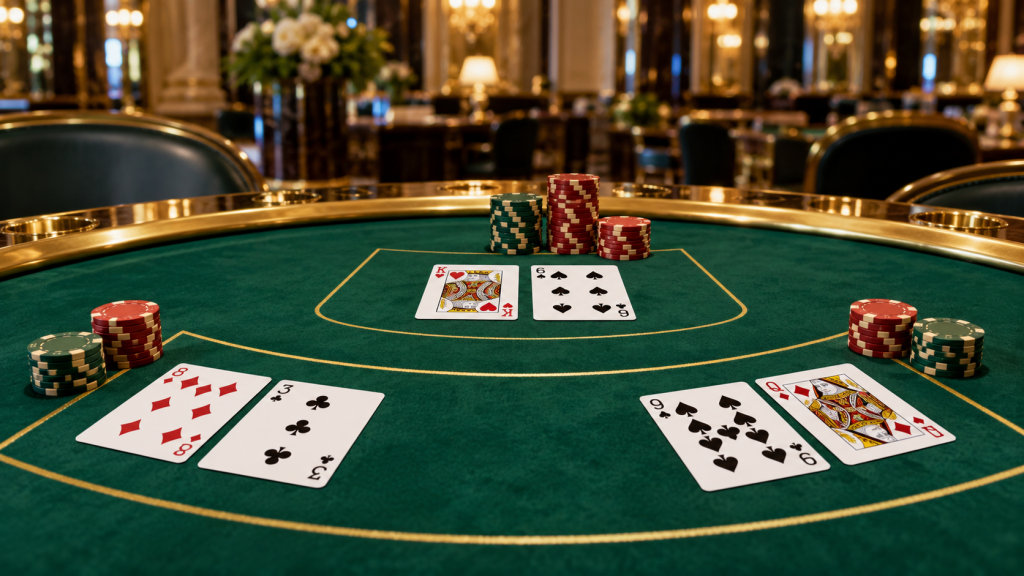
Baccarat Banque is a traditional baccarat variation in which one banker faces two separate player hands. Also called Baccarat à Deux Tableaux, it combines familiar baccarat scoring with a table structure that gives participants more involvement than standard Punto Banco.
For readers researching baccarat through jiliasia, understanding the two player sides is the best place to begin. Each side competes against the banker, and the results are settled separately. The player sides do not compete against each other.
What Is Baccarat Banque?
The traditional game commonly uses three standard 52-card decks. Players sit on either side of the banker, forming two groups represented by two active hands. One banker hand is used against both groups.
Unlike Chemin de Fer, the bank does not automatically pass to another participant after a single losing round. The banker generally continues until the shoe ends, the banking funds are exhausted, or the banker retires under the applicable rules.
| Feature | Traditional Baccarat Banque |
|---|---|
| Common deck setup | Three standard decks |
| Hands in a round | Two player hands and one banker hand |
| Objective | Finish closer to 9 than the opposing hand |
| Player decisions | Limited drawing choices, including a decision on 5 |
| Banker continuity | Not automatically ended by one loss |
| Settlement | Each player side is compared with the banker separately |
Baccarat Banque Card Values
Cards are scored by baccarat values rather than blackjack values. Only the final digit of the total counts.
| Card | Point value |
|---|---|
| Ace | 1 |
| 2–9 | Face value |
| 10, Jack, Queen, King | 0 |
For example, 7 and 8 total 15, making a five-point hand. A King and 9 make nine points. Suits do not determine which hand wins.
How to Play Baccarat Banque
1. Establish the Bank and Accept Bets
The banker commits funds to cover opposing wagers. In the traditional limited-bank arrangement, combined player stakes cannot exceed the amount available in the bank. Rules determine who may wager on each side and whether a stake can be divided between both hands.
2. Deal Two Cards to Each Hand
The traditional sequence is right player side, left player side, then banker, repeated once. Each hand starts with two cards. An initial 8 or 9 is a natural; when a natural is declared, the hands are exposed and settled under the natural-hand procedure.
3. Resolve Drawing Decisions
Without a natural, player hands normally draw on 0–4, may draw or stand on 5, and stand on 6–7. The banker then makes a drawing decision using the information available from both sides. A jiliasia reader should avoid substituting Punto Banco’s automatic banker chart for this traditional decision process.
4. Compare Both Player Hands with the Banker
A banker total of 7 beats a player total of 6 but loses to a player total of 8. The same round can therefore produce different results on opposite sides. Equal totals normally return the affected stake.
Payouts, Fees and Sensible Limits
Winning player stakes are generally settled at even money before any applicable charges. Do not assume that every Banque table uses the familiar 5% commission associated with standard Punto Banco Banker bets. Check the fee basis and settlement rules first.
When planning a session after reading jiliasia content, set a spending limit and keep stakes within it. Increasing wagers after losses does not create a guaranteed recovery.
Frequently Asked Questions
Is Baccarat Banque the same as standard baccarat?
No. Its two player hands, continuing bank and drawing choices distinguish it from Punto Banco.
Does a three-card 9 count as a natural?
No. A natural is an initial two-card 8 or 9.
Can a strategy guarantee a profit?
No. Understanding decisions and fees helps explain the game, but cannot remove financial risk. Use this jiliasia guide as a rules reference rather than a promise of winning results.